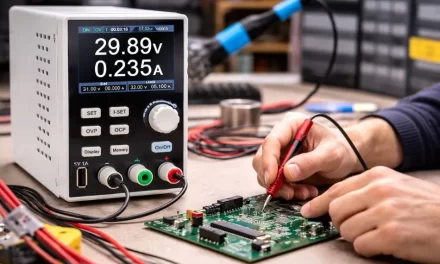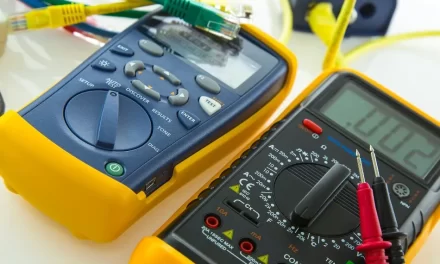
While debugging a circuit or repairing boards or experimenting with electronics, you’ve likely come across a situation where everything seems fine on a multimeter—but the circuit still behaves unpredictably. You might find yourself wasting hours debugging issues that don’t show up in basic measurements.
This is exactly where an LCR meter becomes a game-changer. A multimeter primarily relies on DC measurements, which are useful for quick checks but don’t reflect how components behave in real operating conditions. Inductors, capacitors, and even resistors can respond very differently under AC signals and varying frequencies. An LCR meter addresses this by applying an AC test signal and analyzing the component’s response, giving you a far more accurate and practical understanding of its behavior within a circuit.
Modern LCR meters take this further by measuring key parameters like impedance (Z), phase angle, dissipation factor (D), quality factor (Q), and equivalent series resistance (ESR). These values are often what reveal hidden issues—such as a capacitor that looks fine but has high ESR, or an inductor that doesn’t perform as expected at a given frequency—helping you move from guesswork to precise, reliable diagnosis.
In this guide, we’ll break down how to choose the right LCR meter for your needs. You’ll understand the key factors—like accuracy, frequency range, and measurement capabilities—and explore a curated list of the best handheld LCR meters, so that you can pick the right tool.
Types of LCR Meters
Handheld LCR Meters
Handheld LCR meters are portable, battery-operated devices designed for field work, repair jobs, and hobby applications. They are lightweight and typically include automatic range selection. Most handheld models support test frequencies such as 100 Hz, 120 Hz, 1 kHz, and sometimes 10 kHz or 100 kHz.
For PCB repair, maintenance work, student labs, and general electronics testing, handheld models are more than sufficient. They are also ideal for technicians who need mobility. However, their frequency range and advanced measurement functions may be limited compared to benchtop meters.
Benchtop LCR Meters
Benchtop LCR meters are designed for laboratory, R&D, calibration, and manufacturing environments. They provide higher accuracy, broader frequency control, and advanced analysis features.
Frequency ranges may extend from 20 Hz up to 100 kHz, 200 kHz, or even MHz ranges in high-end instruments. Their accuracy is also better than handheld meters.
Key Factors to Consider When Selecting an LCR Meter
Measurement Accuracy
Accuracy defines how close the measured value is to the actual value of the component. Most entry-level LCR meters provide accuracy within ±1%, which is generally sufficient for hobby and educational purposes. However, professional benchtop LCR meters can provide much higher precision, often ±0.1% or better. If you frequently work with sensitive analog circuits, RF designs, or precision components, investing in a highly accurate meter is recommended.
Test Frequency Range
Passive components behave differently at different frequencies. For example, the capacitance or inductance value measured at 100 Hz may differ significantly from the value measured at 100 kHz or 1 MHz.
Most basic handheld LCR meters support standard test frequencies such as 100 Hz, 120 Hz, 1 kHz, and 10 kHz. Advanced meters may support frequencies up to several megahertz. A wider frequency range allows the user to test components under conditions closer to their actual operating environment.
Measurement Range
The LCR meter should be capable of measuring a wide range of capacitance, inductance, and resistance values. A broader measurement range improves versatility and allows the instrument to be used for multiple applications.
For example, a good LCR meter should be able to measure resistance from milliohms (mΩ) to megaohms (MΩ), capacitance values from picofarads (pF) to millifarads (mF), and inductance from microhenries (µH) to henries (H). Choosing a meter with a wider range ensures compatibility with both small signal components and larger power components.
Resolution
Resolution refers to the smallest change in value that the LCR meter can detect and display. Higher resolution provides better sensitivity and allows users to observe even tiny variations in component values. This becomes especially useful when comparing precision components or troubleshooting sensitive circuits.
For example, an LCR meter with a resolution of 0.001 Ω can detect much smaller resistance changes than a meter with a resolution of 0.1 Ω. Similarly, higher capacitance and inductance resolution helps in accurately matching components in filters, oscillators, and timing circuits.
ESR Measurement Capability
Equivalent Series Resistance, commonly known as ESR, is a very important parameter when testing capacitors, especially electrolytic capacitors. ESR represents the internal resistance present inside a capacitor and directly affects the efficiency and performance of electronic circuits.
A capacitor with high ESR can cause excessive heat, unstable power supplies and poor filtering performance. Therefore, an LCR meter with ESR measurement capability is extremely useful for repairing switching power supplies, motherboards, audio equipment, and industrial electronics. Advanced LCR meters can measure ESR accurately at different frequencies, making them highly valuable for troubleshooting applications.
Q Factor and Dissipation Factor
Many modern LCR meters can measure advanced parameters such as Quality Factor (Q Factor) and Dissipation Factor (D Factor). These parameters help evaluate the efficiency and losses present inside inductors and capacitors. These parameters are especially important in RF applications, filters, oscillators, and high-frequency circuit design.
Auto Range and Manual Range
Most modern LCR meters support both auto-ranging and manual-ranging modes. Auto-ranging automatically selects the most suitable measurement range, making the meter easier and more convenient to use, especially for beginners. Manual ranging, on the other hand, allows experienced users to select a fixed range for faster and more stable measurements.
Display Quality and Readability
The display quality of an LCR meter affects user experience and convenience. A large backlit display makes it easier to read measurements clearly, especially in low-light environments. Some modern meters also feature TFT or OLED displays with better contrast, wider viewing angles, and graphical interfaces. Higher display count is another important factor. A higher count display can show more digits and finer measurement details
Data Logging and PC Connectivity
Modern LCR meters often include data logging and connectivity features that allow users to store and transfer measurement data. Common interfaces include USB, Bluetooth, LAN, and RS-232 communication ports. These features are extremely useful for engineers who need to record measurements, generate reports, perform long-term testing, or integrate the meter into automated testing systems. PC connectivity also enables firmware updates and advanced software-based analysis.
Battery Life and Portability
For field technicians and service engineers, portability is an important consideration. Handheld LCR meters with compact designs and long battery life are more convenient for on-site troubleshooting and repair work. Benchtop LCR meters generally offer better performance and accuracy, but they are less portable compared to handheld models.
Calibration
Calibration support is another critical factor, especially for professional and industrial applications. Over time, measurement instruments may drift from their original accuracy due to aging and environmental factors. A properly calibrated LCR meter ensures reliable and consistent measurements. Professional users should look for meters that support factory calibration, calibration certificates, and traceability standards such as ISO/IEC calibration compliance.
Best LCR Meters Reviews
We’ve analyzed the top handheld LCR meters based on measurement capabilities, test frequencies, accuracy, ease of use, and overall value to help you find the right tool for electronics testing and repair.
DE-5000 Handheld LCR Meter

The DER EE DE-5000 is widely regarded as one of the best handheld LCR meters available. Unlike entry-level LCR meters that only provide basic inductance, capacitance, and resistance measurements, the DE-5000 offers a much deeper level of component analysis through advanced parameters such as equivalent series resistance (ESR), dissipation factor (D), quality factor (Q) and phase angle (θ).
One of the biggest strengths of the DE-5000 is its versatility. It supports five selectable test frequencies allowing users to measure components closer to their intended operating conditions. The meter automatically selects series or parallel equivalent circuits based on the device under test and features a convenient Auto-LCR mode, eliminating the need to manually switch between inductance, capacitance, and resistance measurements. Moreover, its built-in sorting mode allows users to quickly group components according to specified tolerance limits.
Combined with its high-resolution dual display and included accessories such as SMD tweezers and alligator clips, the DE-5000 can be considered as one of the best handheld LCR meters available for serious electronics work. It strikes the best balance between measurement capability, accuracy, features, and value for money.
Key Features
- High-accuracy handheld LCR meter with 19,999/9,999-count dual display.
- Measures inductance, capacitance, and resistance automatically.
- Calculates secondary parameters including ESR, dissipation factor (D), quality factor (Q), phase angle, and parallel resistance (Rp).
- Automatic series and parallel mode selection.
- Auto-LCR mode for one-touch component identification.
- 4-wire Kelvin connection.
- Auto-ranging operation for AC impedance and DC resistance.
- Backlit display for improved readability.
- Includes alligator clips, SMD tweezers, guard lead, and battery.
- Optional USB interface available for PC connectivity.
Technical Specifications
| Test Frequencies | 100 Hz, 120 Hz, 1 kHz, 10 kHz, and 100 kHz |
| Inductance Range | 20 μH to 2,000 H |
| Capacitance Range | 200 pF to 20 mF |
| Resistance Range | 20 Ω to 200 MΩ |
| DC Resistance (DCR) Range | 200 Ω to 200 MΩ |
| Sorting Function | Supported with selectable tolerances of ±0.25%, ±0.5%, ±1%, ±2%, ±5%, ±10%, ±20%, and -20%/+80% |
| Power Supply | 9V battery |
Pros
 Excellent Measurement Accuracy
Multiple Test Frequencies up to 100 kHz.
Advanced Secondary Parameters
Component Sorting Function
Cons
 No native USB interface
User interface feels dated
No built-in rechargeable battery
Who should buy?
- Electronics engineers.
- Repair technicians.
- Advanced hobbyists and makers.
- Power electronics designers.
- Users who need accurate ESR and impedance measurements.
- Educational laboratories.
- Anyone seeking a professional-grade handheld LCR meter without the cost of a benchtop instrument.
Peak Atlas LCR45 LCR and Impedance Meter

The Peak Atlas LCR45 is a compact handheld LCR meter designed for engineers, repair technicians, and advanced electronics enthusiasts who need more than basic component measurements. It doesn’t just measure L, C, and R—it also provides deep impedance analysis, including magnitude and phase, making it suitable for analyzing both individual components and more complex loads.
One of the major strengths of the LCR45 is its flexibility. The meter supports both automatic and manual component selection, as well as automatic or user-selectable test frequencies. You can choose from 1 kHz, 15 kHz, and 200 kHz, allowing measurements to be performed closer to the component’s intended operating frequency. This makes the instrument particularly useful when testing inductors, capacitors, transformers, audio components, where frequency-dependent behavior is important.
The LCR45 continuously updates measurements, providing “fluid” readings rather than taking a single snapshot. This feature is especially useful when tuning inductors or variable capacitors because changes can be observed in real time.
Another important distinction is calibration and accuracy. Each unit is individually calibrated to traceable standards, which is a key requirement in professional environments.
Overall, the Peak Atlas LCR45 occupies a sweet spot between inexpensive hobby-grade meters and expensive benchtop instruments. Its combination of multiple test frequencies, detailed impedance analysis, fine resolution, and ease of use makes it one of the most capable handheld LCR meters available for serious electronics work.
Key Features
- Measures inductance, capacitance, resistance, and impedance.
- Displays complex impedance, admittance, magnitude, and phase.
- Automatic or manual component identification.
- Automatic or manual frequency selection.
- Continuous measurements with hold function.
- High-resolution ADC for improved low-value measurements.
- User-friendly interface.
- Removable gold-plated hook probes.
- Approximately 700 operations per battery set.
- Individually factory calibrated to traceable standards.
| Inductance Range | 0 µH to 2 H |
| Capacitance Range | 0 pF to 10,000 µF |
| Resistance Range | 0 Ω to 2 MΩ |
| Resolution | 0.2 µH, 0.2 pF and 0.2 Ω |
| Accuracy | Resistance: ±1.0%, Inductance: ±1.5%, Capacitance: ±1.5% |
| Test Frequencies | DC, 1 kHz, 15 kHz, 200 kHz |
| Sample Rate | Approximately 1.5 readings per second |
| Battery | 12V GP23 |
Pros
High accuracy and reliability
Multi-frequency testing
True impedance and phase measurement
Continuous measurement
Excellent resolution for small values
Cons
Expensive compared to budget LCR meters
No backlit display (can be limiting in low light)
Limited resistance range (up to 2MΩ)
No advanced UI or graphical display
Who should buy?
- Electronics Engineers & Designers
- Analog & RF Work
- Advanced Hobbyists
- Lab & Calibration Work
Smart Tweezers ST5S Professional LCR Meter

The Smart Tweezers ST5S is a high-precision handheld LCR and ESR meter designed primarily for testing and identifying surface-mount devices (SMDs). Unlike traditional LCR meters that rely on external probes and test leads, the ST5S integrates a precision impedance meter directly into a pair of gold-plated tweezers, allowing users to measure tiny components with one hand. This unique design makes it particularly valuable for engineers working with densely populated PCBs and miniature components.
One of the biggest strengths of the ST5S is its ability to automatically identify resistors, capacitors, and inductors while selecting the appropriate test range and frequency for optimum accuracy. In addition to measuring L, C, and R values, the meter can also display important secondary parameters such as ESR (Equivalent Series Resistance), impedance (Z), quality factor (Q), and dissipation factor (D). Manual modes are available for users who need more control during in-circuit measurements or component analysis.
The ST5S features an integrated rechargeable lithium-ion battery and charges via a standard Micro-USB connection. The high-contrast OLED display presents multiple parameters simultaneously, and the four-direction navigation system allows quick access to manual modes, tolerance settings, and stored offsets. Additional features such as continuity testing, diode polarity detection, audible component sorting, and mathematical offset compensation further enhance its usefulness in laboratory and repair environments.
Overall, the Smart Tweezers ST5S is the great option for professionals and serious electronics enthusiasts who regularly work with SMD components and require fast, highly accurate measurements. While it has a premium price compared to conventional handheld LCR meters, its unique tweezer design, excellent precision, and advanced impedance measurement capabilities make it one of the most specialized and convenient tools available for component-level diagnostics.
Key Features
- High-precision LCR meter with tweezer probes.
- One-handed operation for convenient component testing.
- Automatic component identification and range selection.
- Manual measurement modes for capacitance, resistance, inductance, impedance, and ESR.
- Measures secondary parameters including ESR, Q factor, and dissipation factor.
- Dedicated ESR and impedance measurement modes.
- Dual test signal levels (0.5 Vrms and 1.0 Vrms).
- High-contrast OLED display.
- Capable of testing SMD components as small as 0201 packages.
- Precision Swiss-made gold-plated test leads.
- In-circuit measurement support with improved parallel component handling.
- Built-in continuity and diode polarity testing.
- Audible tolerance mode for component sorting.
- Mathematical offset compensation (Null function).
- Integrated rechargeable Li-ion battery with Micro-USB charging.
- Left- and right-handed display orientation.
Technical Specifications
| Measurement Accuracy | Resistance: ±0.2%, Capacitance: ±0.2%, Inductance: ±0.5% |
| AC test mode Test frequency | 1 kHz, 10 kHz, 120 Hz, 100 Hz |
| Test frequency accuracy | 50 PPM (0.005%), 0.3% for 120Hz |
| Test signal level | 0.41/0.91 +/- 10% Vrms Sine wave |
| Source impedance | 100Ω +/- 1% |
| Resistance R | 0.05 Ω to 9.9 MΩ |
| Capacitance C | 0.5 pF to 9999 μF |
| Inductance L | 0.5 uH to 999 mH |
| Quality factor Q | 0.001 to 1000 |
| Dissipation factor D | 0.001 to 1000 |
Pros
Extremely accurate and reliable
Perfect for SMD components
High-quality gold-plated tips
Excellent for repair and prototyping
Compact, ergonomic design
Cons
Expensive compared to budget LCR meters
Not ideal for large through-hole components
Learning curve for advanced features.
Limited usefulness outside SMD-focused work
Who should buy?
Students, Makers and DIY hobbyists
Extech 380193 Passive Component LCR Meter

The Extech 380193 is a handheld LCR meter that can measure inductance, capacitance, and resistance, along with advanced parameters such as quality factor (Q) and dissipation factor (D).
The meter also provides a dual-display interface with a 20,000/10,000 count backlit display of the primary parameter (L, C or R) with the secondary parameter of Q (quality), D (dissipation). In addition, the included PC interface and Windows-compatible software enable users to log, analyze, and store measurement data, making the meter suitable for laboratory environments.
Another standout feature is the built-in open and short calibration functions, which removes stray impedances introduced by test leads and fixtures from the measured value. This feature improves accuracy for very high or low impedances.
Another major advantage is its built-in test fixture, which allows direct insertion of components for quick and stable measurements. This is especially useful in production environments where multiple components need to be tested rapidly. For more flexible use, external test leads are also supported.
Additionally, the meter includes a PC interface (RS-232), enabling users to log, store, and analyze data on a computer. This makes it suitable for data-driven workflows, such as tracking component performance over time or documenting test results for quality assurance.
However, while the Extech meter offers strong functionality, it operates at only two test frequencies (120Hz and 1kHz), which is limited compared to advanced LCR meters. This restricts its ability to fully analyze frequency-dependent behavior.
Overall, the Extech meter is a reliable LCR meter with solid accuracy and useful data features, but not a fully flexible high-frequency analysis tool.
Key Features
- Dedicated measurement of inductance, capacitance, and resistance.
- Measures parameters like Quality Factor (Q) and Dissipation Factor (D).
- Supports series and parallel equivalent circuit modes.
- Dual 20,000/10,000-count backlit LCD display.
- Built-in component test fixture and external test leads.
- Open and short calibration functions for improved accuracy.
- Programmable Hi/Lo limits for component sorting.
- MAX, MIN, and AVG recording functions.
- PC connectivity with Windows-compatible software.
- Data logging and analysis capability.
- Auto power-off and low battery indication.
Technical Specifications
| Display | Dual 20,000/10,000-count backlit LCD |
| Test Frequencies | 120 Hz and 1 kHz |
| Capacitance Range | Up to 10 mF |
| Inductance Range | Up to 10,000 H |
| Resistance Range | Up to 10 MΩ |
| Measurement Rate | One reading per second |
| Power Source | 9V battery or optional external 12–15V power adapter |
| Auto Power-Off | After 10 minutes of inactivity |
Pros
Accurate and reliable measurements
Dual display improves usability
Built-in test fixture is highly convenient
PC interface enables data analysis
Cons
Limited test frequencies
No DC resistance measurement
Not ideal for high-frequency or RF analysis
Measurement speed is relatively slow.
Who should buy?
- Electronics engineers and technicians.
- Repair professionals.
- Educational laboratories and engineering students.
- Users involved in component matching and sorting.
- Advanced hobbyists who need more precision than a multimeter can provide.
FNIRSI LCR-P1 Multifunction LCR Transistor Capacitor Tester

The FNIRSI LCR-P1 is a high-precision, multi-functional component tester that measures transistors, capacitors, resistors, inductors, diodes, MOSFETs, and batteries. With automatic component recognition, pin identification, and a color display, it simplifies component testing and significantly speeds up troubleshooting and sorting tasks.
One of the biggest advantages of the LCR-P1 is its ability to automatically identify a wide range of components, including NPN and PNP transistors, MOSFETs, JFETs, IGBTs, capacitors, inductors, resistors, diodes, Zener diodes, etc. Once a component is inserted, the device detects the component type, determines the pin configuration, and displays important electrical parameters without requiring any manual setup. This makes it particularly useful when working with unmarked components.
The tester features a 1.44-inch color display, a built-in 300mAh rechargeable battery, and a USB Type-C interface for charging and firmware upgrades. Its replaceable test sockets support both through-hole and SMD components, while the built-in anti-burn protection automatically discharges charged capacitors to prevent accidental damage to the instrument. In addition, the device supports NEC infrared signal decoding, making it useful for remote control testing.
Overall, the FNIRSI LCR-P1 offers an impressive combination of functionality and convenience at an affordable price, making it an excellent choice for component identification, repair work, and general electronics troubleshooting.
Key Features
- Intelligent Auto Component Identification.
- Transistor and Diode Analysis.
- ESR Measurement and Capacitor Analysis.
- Anti-Burn Protection.
- ZIF Socket & SMD Support.
- Infrared (IR) Decoding Feature.
- Portable & Rechargeable Design.
Technical Specifications
| Display | 1.44-inch full-color screen |
| Battery | 300mAh rechargeable lithium battery |
| Charging | USB Type-C (5V/1A) |
| Capacitance Range | 25pF – 100mF |
| Inductance Range | 10µH – 1000µH |
| Resistance Range | 0.01Ω – 50MΩ |
| Transistor Gain (hFE) | 10 < β < 600 |
| Diode Test | Forward voltage < 4.5V |
| Zener Diode | 0.01V – 32V |
| SCR Trigger | Voltage <5V, Current <6mA |
| IR Decoding | NEC protocol supported |
Pros
Extremely versatile
Automatic component identification saves time
Accurate enough for hobby and repair use
Compact and portable design
Great for sorting unknown components and diagnostics
SMD testing support adds flexibility
Cons
Unreliable transistor pin identification
Not suitable for precision or professional use
Requires careful handling
Cheap quality test leads
Who should buy?
- Hobbyists & DIY Electronics Enthusiasts.
- Students & Learners.
- Makers & Arduino Users.
ZT-102L LCR Meter

The ZOYI ZT-102L is a multifunction True-RMS meter capable of measuring AC/DC voltage, current, resistance, capacitance, inductance, diode voltage, continuity, and duty cycle. For technicians who travel frequently, carrying one instrument instead of two is a major advantage.
Unlike dedicated LCR meters such as the DE-5000 or Peak Atlas LCR45, the ZT-102L focuses on versatility rather than advanced component characterization. It lacks features like multiple test frequencies, ESR measurement or Q factor, but it compensates with voltage and current measurement capabilities that most LCR meters do not offer.
The meter features a 6000-count True RMS display, allowing more precise readings. It supports AC/DC voltage up to 600V and current up to 600A, making it suitable not just for electronics but also for electrical and automotive applications. The meter also includes features such as a backlit LCD, data hold, continuity buzzer, low battery indication, ceramic fuse protection, non-contact voltage detection (NCV), and a fold-out stand for hands-free operation. Its durable ABS housing provides additional protection against accidental drops, making it suitable for workshop, field, and automotive environments.
Overall, the ZOYI ZT-102L is an ideal all-in-one tool for troubleshooting and general-purpose testing.
Key Features
- Measures AC/DC voltage, AC/DC current, resistance, capacitance, inductance, and duty cycle.
- Supports diode testing and continuity checking.
- Automatic inductance range selection.
- 6000-count backlit LCD display for improved readability.
- Non-contact voltage (NCV) detection for quick electrical checks.
- Ceramic fuse protection for enhanced safety.
- Data Hold function for recording measurements.
- Fold-out support stand for convenient bench use.
- Rugged ABS housing with drop resistance.
- Compact and lightweight design suitable for portable use.
- Low battery indicator and continuity buzzer.
Technical Specifications
| Display | 6000-count LCD with backlight (True RMS) |
| DC Voltage Range | Up to 1000V |
| AC Voltage Range | Up to 750V |
| Current Measurement | Up to 600A |
| Inductance Measurement | 6mH – 60H |
| Capacitance Measurement | 6nF – 60mF |
| Resistance Measurement | 600Ω – 60MΩ |
| Diode Test Voltage | 3.9V, 5mA forward current |
| Operating Temperature | -20°C to 1000°C |
Pros
Compact and portable design
True RMS improves real-world accuracy
Auto range simplifies usage
Decent accuracy for general measurements
Cons
Poor accuracy for low inductance values
Struggles with low-value measurements
No manual range selection
NCV sensitivity is limited
Continuity response is slightly slow
Who should buy?
- DIY electronics enthusiasts.
- Field service technicians.
- Automotive repair professionals.
- Electricians and maintenance personnel.
- Students learning electronics and electrical engineering.
- Hobbyists looking for an all-in-one portable meter.
Proster LCR Meter

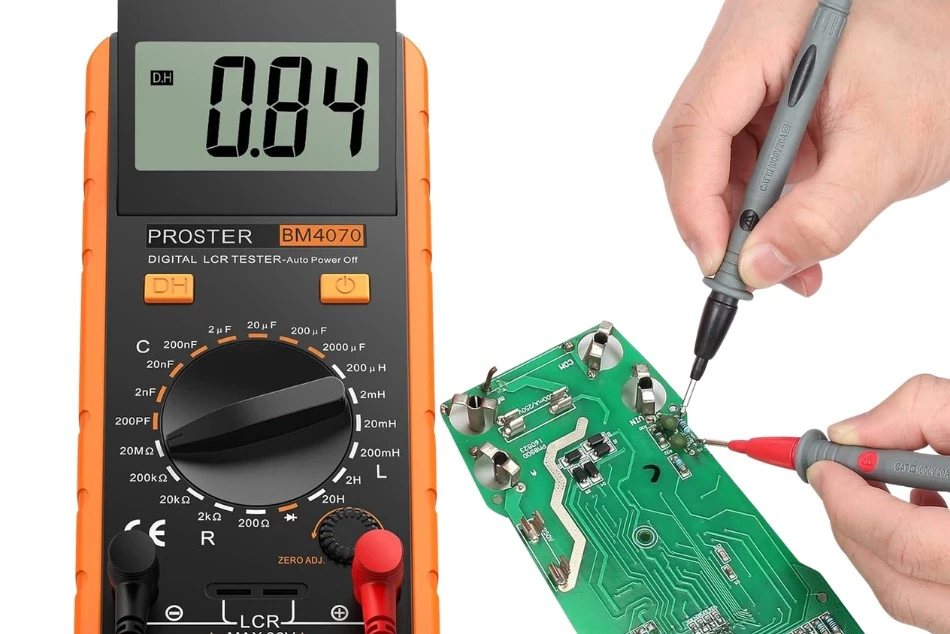
The Proster Digital LCR Meter is an entry-level instrument designed for measuring inductance (L), capacitance (C), and resistance (R) in everyday electronics work. It features a compact handheld design with a large LCD display that can be rotated for easier viewing. The display angle adjustment allows users to place the meter on a workbench without having to constantly hold it, which improves convenience during prolonged testing sessions.
The device supports a wide measurement range—from 200 pF to 2000 µF for capacitance, 200 µH to 20 H for inductance, and 200 Ω to 20 MΩ for resistance—making it versatile enough for most PCB-level diagnostics and component testing. This means you can test everything from small ceramic capacitors and SMD resistors to larger electrolytic capacitors and inductors used in power circuits.
Features such as Data Hold, Auto Power-Off, Low Battery Indication, and Zero Adjustment for capacitance measurement simplify everyday operation. These functions help improve measurement accuracy and enhance battery life. It comes with test leads, crocodile clips, a mini screwdriver, a 9V battery, a user manual, and a portable storage bag.
Overall Proster is an affordable dedicated LCR meter for everyday component testing, it offers solid value and represents a worthwhile addition to any DIY electronics toolkit.
Key Features
- Wide Measurement Capability
- Rotatable Display
- ZERO Adjustment (Capacitance Calibration)
- High Accuracy
- Durable Construction
Technical Specifications
| Display | 3½ digit LCD (max 1999 count) |
| Capacitance Range | 200 pF to 2000 µF |
| Inductance Range | 200 µH to 20 H |
| Resistance Range | 200 Ω to 20 MΩ |
| Capacitance Accuracy | up to ±2.5% to ±5% |
| Inductance Accuracy | up to ±3% to ±5% |
| Sampling Rate | ~3 readings per second |
| Power Supply | 9V battery |
| Display Feature | Rotatable/tiltable LCD |
Pros
Excellent value for money
Easy to use with large display and simple interface
Fast and stable readings
Adjustable display improves usability
Cons
Inductance accuracy issues at low values (µH range)
No input protection (no fuse)
Limited precision compared to professional LCR meters
Who should buy?
- Hobbyists & DIY Electronics Builders
- PCB Repair Technicians (Entry-Level)
- Students & Educational Labs
How We Selected and Reviewed These LCR Meters?
To create this list, we followed a structured research process focused on the features and capabilities that matter most in real-world electronics work. Rather than simply comparing prices or marketing claims, we identified the key factors that determine the usefulness of an LCR meter, including measurement accuracy, supported test frequencies, secondary parameters such as ESR and quality factor (Q), component sorting capabilities, ease of use, included accessories, and overall value for money.
We carefully studied official product specifications, user manuals, datasheets, and manufacturer documentation to verify each meter’s capabilities and measurement ranges. We also considered long-term reputation within the electronics community, and feedback from engineers, technicians, and verified users. Special attention was given to products that consistently receive positive feedback from engineers, repair technicians, makers, and electronics enthusiasts.
Instead of ranking products solely by specifications, we selected models that excel in different categories and budgets. The result is a well-rounded list that helps you choose the best LCR meter based on your specific applications and requirements.
Bottom Line
After comparing specifications, features, capabilities, and overall value, three models stand out from the competition.
The DE-5000 offers the best combination of measurement accuracy, multiple test frequencies, ESR analysis, component sorting, and overall value. For most electronics enthusiasts, repair technicians, and engineers, this is the handheld LCR meter to beat.
If you need a versatile component analyzer for capacitors, transistors, MOSFETs, diodes, and ESR testing without spending much, the FNIRSI LCR-P1 delivers exceptional functionality at an affordable price.
For professionals working with miniature SMD components and board-level troubleshooting, the Smart Tweezers ST5S offers unmatched convenience and precision. Its integrated tweezer design and high accuracy make it one of the most specialized handheld LCR meters available.
FAQ’S
What is the difference between a multimeter and an LCR meter?
A digital multimeter is a general-purpose instrument used to measure voltage, current, continuity, and resistance. Some advanced multimeters can also measure capacitance and inductance, but their accuracy and capabilities are usually limited. An LCR meter, on the other hand, is specifically designed to measure inductance (L), capacitance (C), and resistance (R) with much higher precision. Many LCR meters can also calculate additional parameters such as ESR, quality factor (Q), dissipation factor (D), and phase angle, making them better suited for electronics design, troubleshooting, and component analysis.
What is the difference between an LCR meter and an ESR meter?
An ESR meter is primarily designed to measure the equivalent series resistance of capacitors. An LCR meter is a more versatile instrument that measures inductance, capacitance, resistance, and often ESR as well. Therefore, a good LCR meter can usually replace an ESR meter, while an ESR meter cannot replace an LCR meter.
Can an LCR meter measure DC resistance?
Yes. Many modern LCR meters can measure DC resistance (DCR) in addition to AC impedance. This feature is particularly useful when testing inductors, transformers, and coils.
Do I need an LCR meter if I already have a multimeter?
If you only perform basic electrical measurements, a multimeter may be sufficient. However, if you frequently work with electronic circuits, repair PCBs, test capacitors and inductors, or design power supplies and filters, an LCR meter provides much more accurate and detailed information than a standard multimeter.
Can an LCR meter test components on a PCB?
Yes, but with limitations. In-circuit measurements can be influenced by parallel components and surrounding circuitry, which may affect accuracy. For the most reliable results, components should ideally be removed from the circuit before testing. Some premium meters, such as Smart Tweezers, offer improved in-circuit measurement capabilities.
Why do LCR meters use different test frequencies?
Electronic components behave differently at different frequencies. Capacitors, inductors, and impedance values can vary depending on the frequency of the test signal. Multiple test frequencies allow an LCR meter to characterize components more accurately and simulate their real operating conditions.
What test frequency should I use on an LCR meter?
The appropriate test frequency depends on the component being measured. Electrolytic capacitors are commonly tested at 100 Hz or 120 Hz, while ceramic capacitors and small inductors are often measured at 1 kHz, 10 kHz, or even 100 kHz. Consulting the component datasheet is usually the best way to determine the recommended test frequency.
Are handheld LCR meters accurate enough for professional work?
Yes. High-quality handheld models provide good accuracy and are widely used by engineers and repair professionals. However, laboratory-grade benchtop LCR meters still offer superior accuracy, wider frequency ranges, and more advanced analysis capabilities.