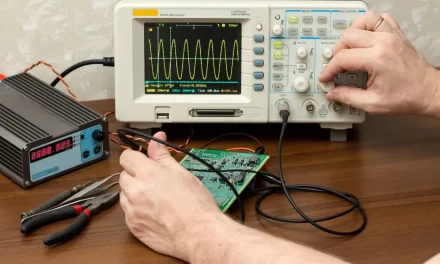

Function generators are important tools for anyone working in electronics—from hobbyists tweaking analog circuits to engineers validating complex systems. These instruments produce various waveforms—sine, square, triangle, sawtooth, and pulse over a wide range of frequencies—with adjustable amplitude, frequency, and DC offset. It allows you to simulate real-world electrical signals—whether you’re fine-tuning a filter, testing a microcontroller, or checking linearity in circuits like ADCs/DACs, making testing and design faster, and far more reliable. Many modern function generators like Arbitrary waveform generators also generate pulse, ramp, and arbitrary waveforms for applications requiring the most flexibility and precision.
The right function generator on your bench can make all the difference between struggling through guesswork and working with clarity and precision. In this article, we’ve curated the list of best function generators available. Explore our top picks and what things you should consider before making your choice.
Key Parameters to Consider Before Selecting a Function Generator
When selecting a function generator, it’s important to understand the key specifications that will impact its performance. Let’s discuss some of these critical parameters.
Output Amplitude Range
The output amplitude range is the span of signal voltage levels the generator can produce, usually specified in peak-to-peak volts. It indicates how strong or weak a signal you can generate. The amplitude range of the function generator should cover both the minimum and maximum signal levels you’ll use.
Resolution
Resolution is the smallest step by which you can adjust the frequency of the function generator. High resolution means you can make very fine changes. It is important for precise tuning and signal fidelity. Modern function generators, especially those based on Direct Digital Synthesis (DDS), often have extremely fine frequency resolution – sometimes on the order of microhertz (1 µHz) steps.
Precision
Precision refers to how closely the generator’s output matches with the specified settings, and how stable those outputs remain over time. High precision is critical when you need reliable and repeatable signals. If you are calibrating or testing sensitive circuits, frequency error or drift can cause problems. A precise function generator ensures the signal stays on the desired frequency with minimal drift over time or temperature changes.
Bandwidth
In function generators, bandwidth refers to the range of frequencies the generator can accurately generate. If you need high-frequency sine waves, you need a generator with sufficient bandwidth so the signal isn’t distorted or attenuated. For instance, generating a 50 MHz sine wave on a 20 MHz bandwidth generator would result in a severely reduced amplitude or no output at all.
Record Length
Record length is the amount of memory available for storing custom waveform points. A longer record length means you can load more long-duration custom waveforms. Simple function generators typically have a small fixed waveform memory. However some High-end AWGs offer very deep memory with which you can play back a long non-repeating signal or multiple segments of waveforms.
Output Frequency Range
It tells you the range of frequencies the function generator can produce for its standard waveforms such as sine, square, etc. It usually has a minimum frequency (often very low, in the millihertz range) and a maximum frequency. Basic models offer around 1 MHz to 5 MHz, mid-range offer 20 MHz to 50 MHz, and more advanced units can reach 100 MHz or higher. You must ensure the generator’s frequency range covers all the signals you need.
Number of Channels
It specifies how many independent outputs the function generator has. Basic models come with one or two channels, but some advanced devices offer four or more channels. Each channel can typically be set to generate a different waveform with its own frequency, amplitude, etc.).
Multiple channels allow you to do more with one device, however, more channels increase cost.
Noise and Jitter
In a function generator, noise and jitter are important factors that can affect signal integrity and the precision of output.
Noise refers to any unwanted component or interference in the output signal. It can come from interference from other devices or thermal effects. Excessive noise can distort the signal, making measurements inaccurate.
Jitter is a specific type of noise which affects timing of the output signal. It refers to variability in the exact timing of signal transitions. Jitter can introduce uncertainty and error specifically in digital communication. In digital systems, timing is everything, even a small shift in the clock signal can cause data errors. In communication systems, jitter leads to phase uncertainty and signal distortion, which can break synchronization.
Connectivity options
Modern function generators often provide several connectivity options such as USB, LAN (Ethernet), or GPIB (General Purpose Interface Bus). USB is the most common and user-friendly way to connect directly to a PC for control, data logging, or using custom software. Ethernet (LAN) is better suited for modern labs and automated systems, as it allows remote control over networks and makes it easy to integrate multiple devices into one setup. GPIB, though older, is still used in many laboratories because it ensures compatibility with existing equipment.
Sample Rate
In digital function generators (especially AWGs), signals are not created directly in analog form. Instead, they’re first represented digitally as a sequence of points that describe the waveform. The sample rate is the speed at which the generator converts these data points into an analog signal using a Digital-to-Analog Converter (DAC). It is measured in samples per second (Sa/s).
A higher sample rate gives smoother, more accurate waveforms because there are more data points representing the signal. A low sample rate makes signals look stair-stepped or distorted. To represent a waveform correctly, the sample rate should be at least twice the highest frequency of the desired signal. For example, if you want a 50 MHz sine wave, your generator should run at least 100 MS/s.
Frequency Stability
This refers to how well the function generator can maintain its frequency over time and whether it can synchronize with external references or other generators. Choose a function generator with robust frequency stability for precision and reliability of your work.
Phase lock capability
This refers to a function generator’s ability to synchronize the timing and phase of its output signal with an external reference clock or another generator. This is especially important in applications where precise synchronization is required, such as phased array radar, multi-antenna communication systems, beamforming, differential signaling, and complex modulation testing.
By locking signals together, you can simulate realistic multi-channel environments, test advanced wireless standards like 4G/5G MIMO, or coordinate interference and multi-tone signal generation without drift or misalignment.
Modulation Capabilities
Modulation is the process of changing one or more properties of a waveform (called the carrier signal) to encode information. The properties that can be varied are amplitude, frequency, or phase. In communication systems, modulation is how information—like voice, video, or data—is carried over a signal.
Modulation capability in a function generator allows it to simulate real-world signals used in communication. Common modulation types include AM (Amplitude Modulation), FM (Frequency Modulation), PM (Phase Modulation), and sometimes more complex modulation like PWM (Pulse Width Modulation).
These features are important because most real systems—like wireless devices, motor controllers, and filters—don’t operate with pure signals, but with modulated ones carrying information. By adding modulation, a function generator helps engineers test, design, and troubleshoot circuits under realistic conditions.
Top Function Generators to Consider
Seesii DDS Signal Generator
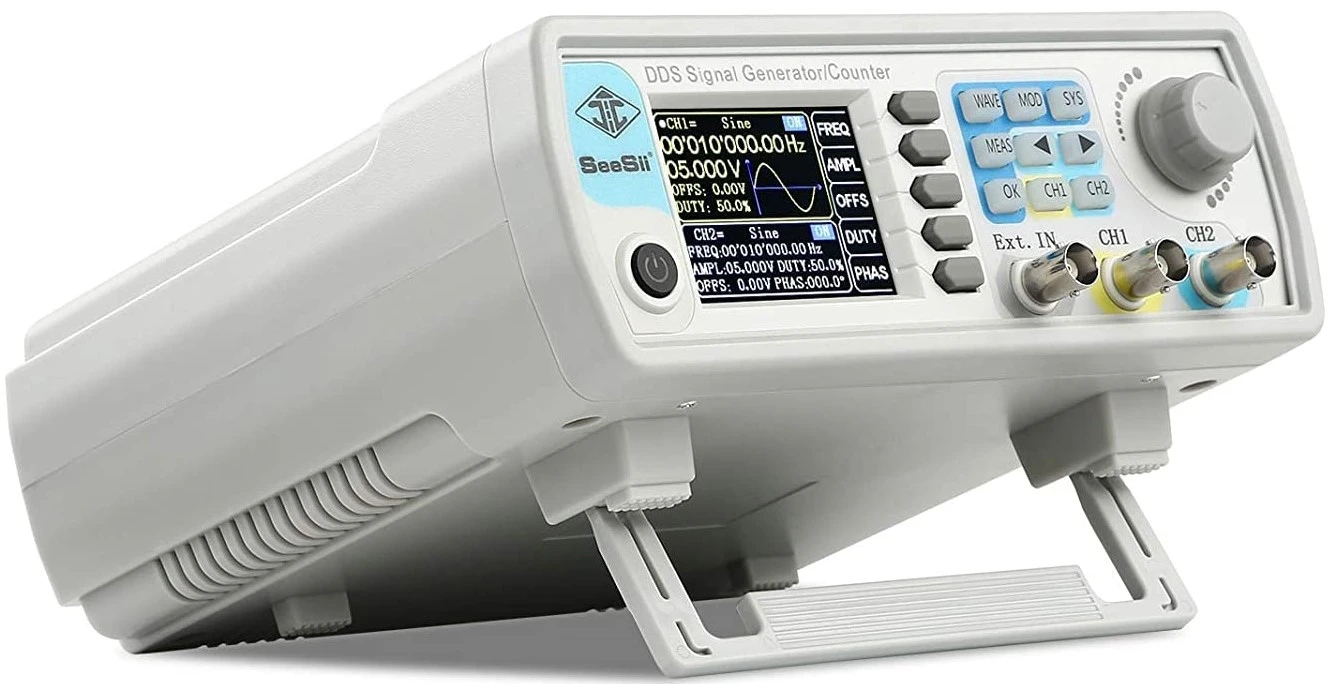
The Seesii Professional DDS Signal Generator (model FG-615) is a dual-channel function generator. Being a DDS-based generator, it can produce a variety of waveforms: sine, square, triangle, sawtooth, pulse, and even user-defined arbitrary waveforms. You can connect the generator to a PC to upload custom wave shapes (the Seesii comes with PC software for this).
It features a 2.4-inch high-definition color LCD display. It provides dual synchronized channels, which is useful for creating two signals at once or even two-phase outputs. Each channel’s waveform, amplitude, frequency, duty cycle, and phase can be set independently.
The device also includes a built-in frequency counter function for measuring external signals. Internally, it uses a high-speed MCU and FPGA-based DDS clock generation, giving it good signal stability and precision. Additionally, it provides a sweep function for testing frequency response, and can perform frequency/period measurements and pulse width measurements on external signals. Up to 99 user presets can be stored and recalled, which is convenient for saving frequently-used configurations.
This function generator is suitable for electronics engineers, educators, or hobbyists who need standard test waveforms, modulated signals, or sensor signal simulation.
Key Features
- Dual-channel design with independent control
- High stability and accuracy
- Wide waveform library
- Stores up to 99 user settings
- Built-in sweep (linear/logarithmic), burst, and counter functions
- Compact, lightweight, and portable design
Koolertron DDS Signal Generator

The Koolertron 30 MHz DDS Signal Generator is a dual-channel arbitrary waveform generator that can generate sine, square, triangle, pulse, Half-wave, Full-Wave, Noise, Exponential Rise, Exponential Fall, Tone, Sinc Pulse, Lorentz Pulse, and 60 kinds user defined waveform. It has a 2.4-inch color display.
It provides frequency output of Sine waves up to 30 MHz (15 MHz for square/triangle). With 200MSa/s sampling rate and 14-bit vertical resolution, it can produce cleaner and more accurate waveforms at the top end of its range. Users can also store 60 custom waveforms of length 2048 points each in its memory.
The Koolertron 30MHz generator is well-suited for more advanced electronics testing, where higher frequency signals or more complex waveforms are needed. For example, it can handle RF experiments into the tens of MHz, or provide test signals for high-speed digital circuits. Despite its advanced capabilities, it is an affordable option for a 30 MHz class generator.
Key Features
OWON Function Generator DGE1030
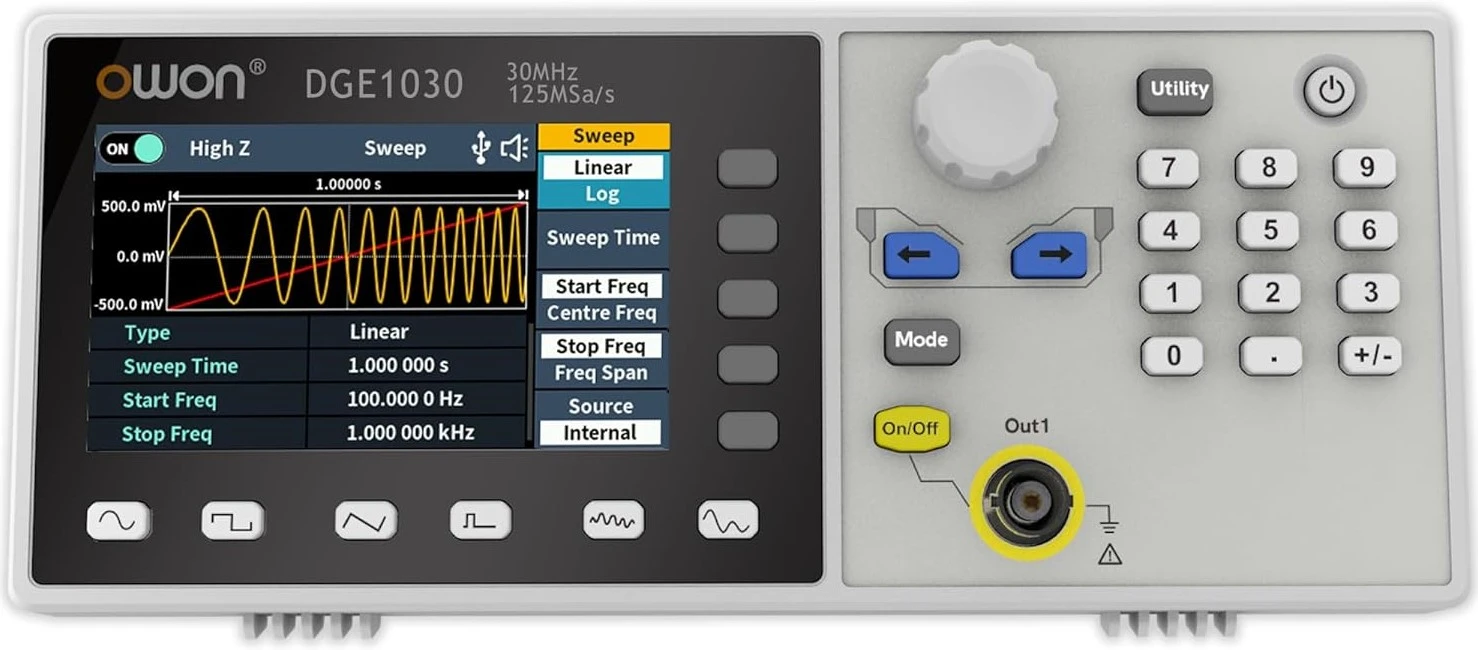
The OWON is a high-value, single-channel Function Generator that provides high-fidelity output signals at an affordable price. With a 30 MHz maximum output, 125 MSa/s sampling rate and 14-bit resolution, it provides you the flexibility and precision needed for both analog and digital signal testing. Its advanced DDS architecture supports standard waveforms like sine, square, triangle, ramp, pulse. It also offers a library of over 160 built-in arbitrary waveforms. For signal modulation and complex stimulus, it includes AM, FM, PM, FSK, as well as sweep and burst modes.
The 3.6-inch TFT color display provides a clear, intuitive interface, and shortcut keys speed up access to commonly used functions. Additionally it includes several features such as configuring screen brightness, screen saver timeout, USB mode, load settings, language, and audio beeps. This function generator is ideal for students, hobbyists and professional engineers.
Key Features
- 14-bit vertical resolution for high signal fidelity and low quantization error
- Provides more than 150 kinds of built-in arbitrary waveforms
- Modulation modes: AM, FM, PM, PWM, FSK
- Sweep and burst functions
- USB interface (device/host) for connectivity and waveform upload
- LCD or color display (likely 3.6” or similar) to visualize settings and menus
- Output amplitude range 50 Ω
- DC offset capability with fine resolution
- Includes 16 non-volatile digital arbitrary waveform storage functions
FY6900 Function Generator

The FY6900-60M is a budget-friendly, dual-channel DDS waveform generator that packs pro-level functions into a compact bench unit. It is a 14-bit high-speed DAC running at 250 MSa/s, that delivers low-distortion signals, rich modulation, sweep/VCO/burst, a 100 MHz counter/frequency-meter, and PC control—making it a versatile choice for students, hobbyists, and engineers who need more than a basic function generator. It enables us to store 64 arbitrary waveform data with each one of waveform storage depth 8192 points * 14 bits.
The waveforms include AM/FM/PM/ASK/FSK/PSK modulation, linear/log sweep of frequency/amplitude/offset/duty, VCO (external voltage controls freq/amp/offset/duty/PWM), and burst (1 to 1,048,575 pulses; triggers from CH2, external, or manual). It also features a 2.4-inch 320×240 TFT that shows both channels at once.
The built-in counter measures frequency, period, pulse width, and duty cycle up to 100 MHz with selectable gate times (1/10/100 s) and AC/DC coupling—handy for quickly characterizing oscillators or checking external sources without a separate counter.
Key Features
- 64 user waveforms (8 k pts each), 33 presets
- 2.4-inch TFT LCD display interface
- Direct Digital Frequency Synthesizer (DDS) technology for stable, accurate, low-distortion signals.
- 14-bit high-speed DAC with 250 MSa/s sample rate
- Multiple modulation types: AM, FM, PM, ASK, FSK, PSK
- VCO (Voltage Controlled Oscillator) function
- 100 MHz frequency meter
- Counter function with AC and DC coupling modes
- Output short-circuit protection
DROK Frequency Generator
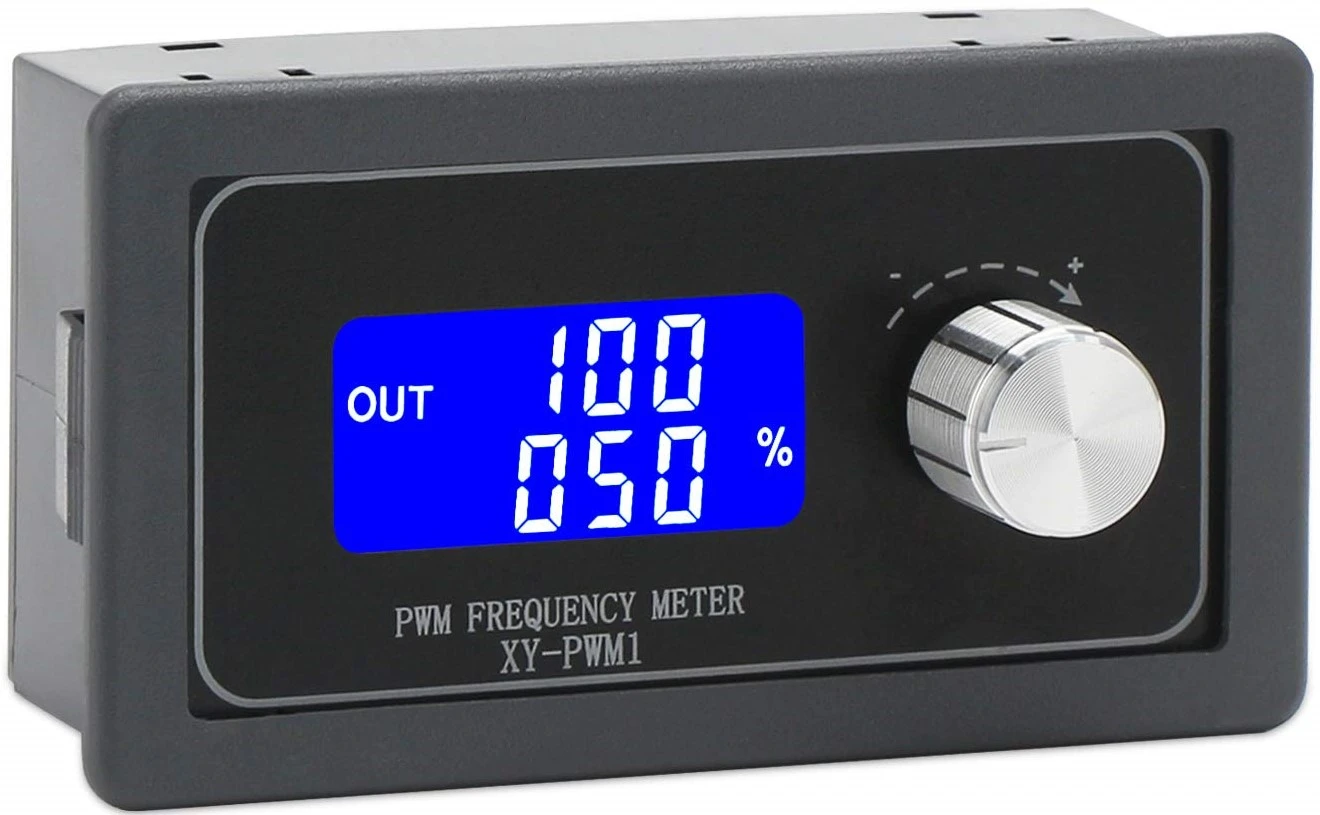
The DROK is a compact, budget-friendly signal generator designed for hobbyists, students, and engineers. It primarily outputs / pulse / PWM (pulse width modulated) signals with adjustable frequency and duty cycle, making it ideal for driving motors, controlling circuits, or testing microcontroller inputs.
Designed for both bench use and integration into electronics systems, the module supports a 3.3 V to 30 V DC supply, and delivers up to 5–30 mA output current. It also supports serial (UART / TTL) communication for remote control in automated setups. The generator includes both a “normal” mode for full-range adjustment and an “accurate” mode for finer duty resolution at lower frequencies. This generator is good for learning PWM control, experimenting with duty cycles.
Key Features
- Wide supply voltage tolerance 3.3 V to 30 V
- Dual modes (normal + accurate) give you flexibility
- Good output current for small loads (5–30 mA)
- Simple UI with automatic scaling
- The lock and adjustable bounds features
- Very compact and low-cost