A microcontroller is a compact integrated circuit (IC) that combines a Central Processing Unit (CPU), memory (Flash, RAM, and EEPROM), and input/output (I/O) peripherals on a single chip. It is designed for specific task in embedded applications. Once the program is embedded on the microcontroller chip it cannot be changed until you have a specific programmer to burn the code into microcontroller chip. It is optimized to control electronic devices. It is like a small computer on a single chip.
Microcontrollers are programmed to perform a specific task repeatedly and efficiently. Once programmed, they can read data from sensors, process the information, and control devices such as motors, LEDs, displays, relays, and communication modules. Since everything required for processing is available on the chip itself, microcontroller-based systems are simpler to design and require fewer external components.
Today, microcontrollers are found in countless everyday electronic devices. They are used in washing machines, microwave oven, traffic light control, smartwatches, LED control panel, TV remote, temperature control etc. Development boards such as Arduino Uno, ESP32, and STM32 have also made microcontrollers extremely popular among students, hobbyists, and engineers for building embedded and IoT projects.
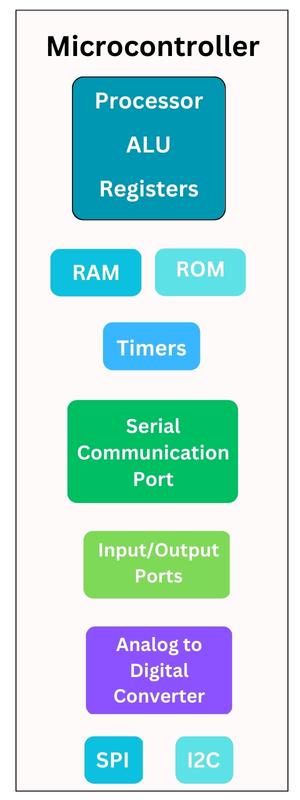
In simple terms, a microcontroller is like a small computer on a single chip that is optimized to control, and automate specific tasks. Its combination of integrated memory, built-in peripherals, low power consumption, and affordable cost makes it the preferred choice for modern embedded systems and smart electronic devices. Block diagram of microcontroller is shown as follows:
Differences between Microprocessor and Microcontroller
The following table highlights the key differences between a microprocessor and a microcontroller.
| Feature | Microprocessor | Microcontroller |
|---|---|---|
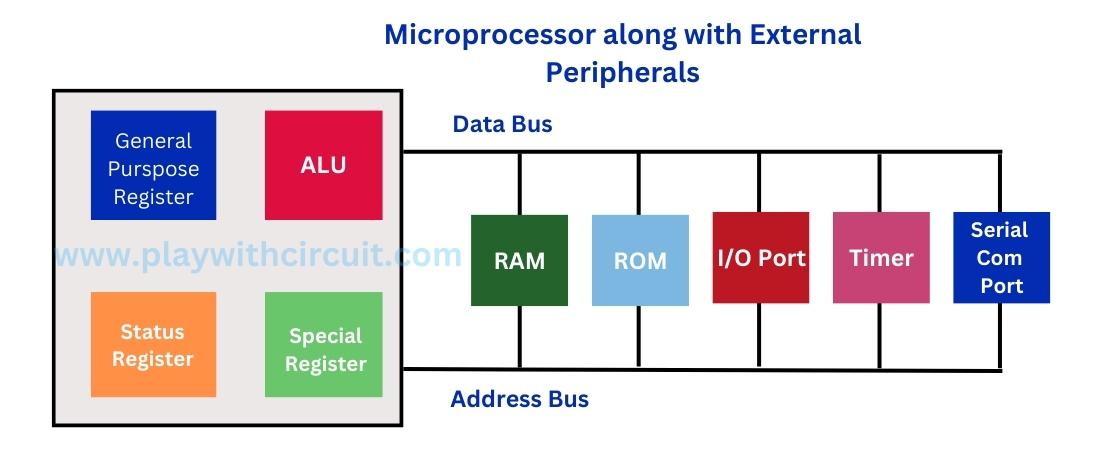
| Definition | The microprocessor consists of a CPU only. It requires external components like memory (RAM, ROM), I/O ports, and timers for functionality. | Microcontroller has CPU along with memory, I/O ports, timers and other peripheral embedded on a single chip. |
| Components | It requires external RAM, ROM, I/O ports, timers, and communication interfaces. | It Includes CPU, Flash memory, RAM, EEPROM, GPIO, timers, and communication peripherals internally. |
| Primary Purpose | Microprocessor is designed for high-performance computing and multitasking. | Microcontroller is generally used in embedded applications. |
| Processing Power | Computational capacity of microprocessor is very high. It can perform Complex tasks. | Computational capacity of microcontroller is less as compared to microprocessor. It is used to perform simple tasks. |
| Clock Speed | The clock frequency is high usually in GigaHertz. | The clock frequency is less usually in MegaHertz. |
| Examples | Some examples of microprocessor are Intel® Core™ processors, AMD Ryzen™, Intel Pentium®. | Some example of microcontroller are 8051, AVR ATmega328P, Arduino, PIC16F877A, ESP32, STM32. |
| Peripheral Devices | Most peripherals are connected externally. | Most peripherals are integrated into the chip. |
| Multitasking | Microprocessor based system can perform numerous tasks. | Microcontroller based systems perform specific tasks. |
| Architecture | Microprocessor are based on Von Neumann model/architecture where program and instruction data are stored in same memory module. | Microcontroller are based on Harvard architecture where program and data instructions are stored separate. |
| Power Consumption | Due to external components, power consumption of microprocessor based system is high. | Since all the component are present on the chip, its power consumption is low. |
| System Size | Systems with microprocessors are larger due to the external components like memory and I/O devices. | More compact since everything is integrated on a single chip, making circuit designs simpler and smaller. |
| Cost | The cost of systems built using microprocessors is high because external peripheral devices are attached with it. | The cost of systems using microcontroller is low because circuitry required for processing is integrated on a single chip. |
| Circuit Complexity | It is complex and it needs to process a large number of instructions. | It is simple, and it processes a smaller number of instructions. |
| Boot Time | Longer because an operating system must be loaded. | Very fast, often starting execution immediately after power-up. |
| Typical Applications | Desktop computers, laptops, servers, gaming systems, and workstations. | Home appliances, IoT devices, robotics, industrial automation, automotive electronics, and consumer electronics. |
| Advantages | High performance, supports large applications, and offers excellent multitasking capabilities. | Compact, energy-efficient, cost-effective, and easy to integrate into embedded systems. |
| Best Suited For | Applications demanding maximum computing performance. | Applications requiring dedicated control, automation, and low power consumption. |
Which One Should You Choose?
The choice between a microprocessor and a microcontroller depends entirely on your application’s requirements.
Choose a microprocessor for:
- High processing performance
- Multitasking capabilities
- A full operating system such as Windows or Linux
- Large memory support
- Complex applications like gaming, AI, video editing, or desktop software
Choose a microcontroller for:
- A compact and cost-effective solution
- Low power consumption
- Real-time monitoring and control
- Battery-operated devices
- Embedded applications such as robotics, IoT, home automation, automotive electronics, or industrial control systems
In simple terms, if your goal is to build a powerful computing system, a microprocessor is the better choice. If you want to control hardware, read sensor values, or automate a specific task, a microcontroller is the ideal solution.
FAQ’S
What is the main difference between a microprocessor and a microcontroller?
A microprocessor contains only the CPU and requires external memory and peripherals, whereas a microcontroller integrates the CPU, memory, and peripherals on a single chip.
Why are microcontrollers cheaper than microprocessors?
Microcontrollers integrate CPU, memory, and peripherals on a single chip, reducing the need for additional external hardware and lowering the overall system cost.
Which is better for IoT projects?
Microcontrollers such as ESP32, STM32, and AVR are commonly used in IoT devices because of their low power consumption, built-in communication interfaces, and affordability.
Can a microprocessor be used in embedded systems?
Yes. High-performance embedded systems such as industrial controllers, medical equipment, and networking devices often use microprocessors when advanced computing capabilities are required.
Why do computers use microprocessors instead of microcontrollers?
Computers need high processing power, multitasking, large memory support, and the ability to run sophisticated operating systems, making microprocessors the ideal choice.