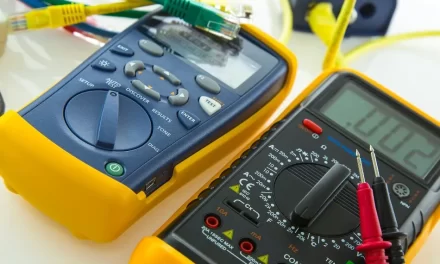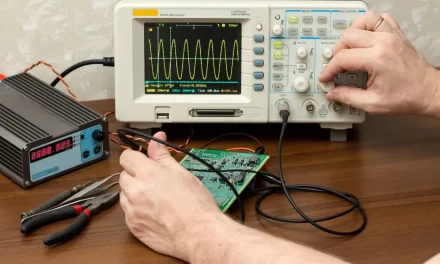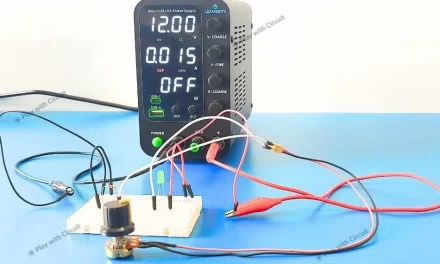
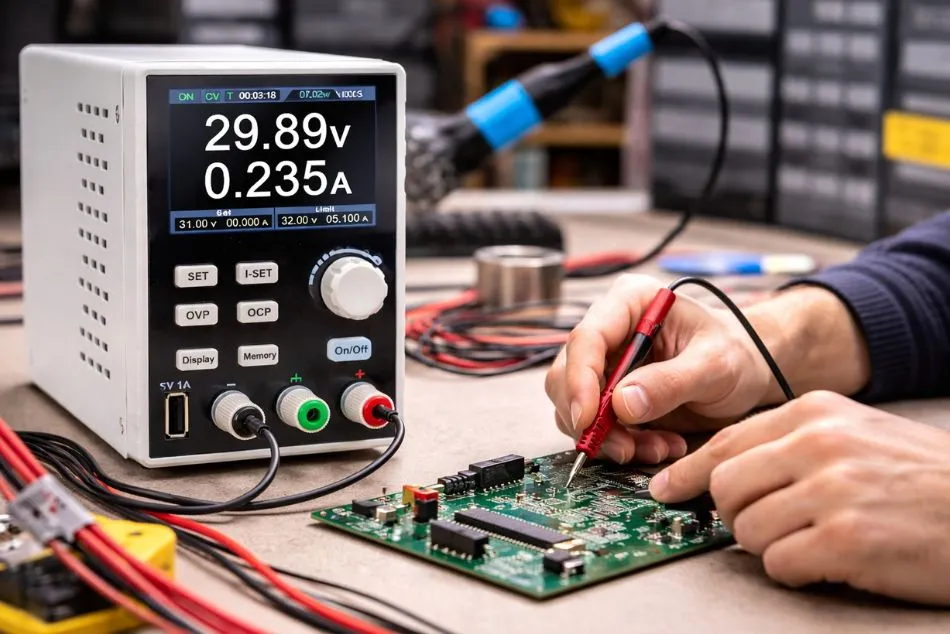
Power-related issues are some of the most common and frustrating problems in electronics work, especially during testing and prototyping. In several cases, these problems are not caused by faulty components or incorrect code, but from the way the circuit is powered.
Batteries, USB ports, or fixed adapters are convenient, but they offer very limited insight into what is actually happening inside a circuit. For simple projects they often work just fine but as projects grow more complex small problems begin to appear. A microcontroller may reset unexpectedly, an LED may draw more current than anticipated, or a component may heat up without an obvious reason. Without knowing how much voltage or current a circuit is actually using, it becomes difficult to understand what is going wrong and troubleshooting turns into guesswork.
A bench power supply addresses these challenges by providing a stable and adjustable DC power source with real-time voltage and current monitoring. It allows you to set a specific output voltage and limit the maximum current before powering a circuit and observe how your design responds under different conditions. This makes prototyping safer and more reliable.
Importantly, you do not require expensive or high-end laboratory equipment to gain these benefits. Today, there are many affordable, compact, and easy-to-use DC bench power supplies. In this guide, we will walk you through what key factors to consider before buying one. We will also review some of the best budget-friendly DC bench power supplies to help you choose the right option that fits your projects, and budget.
Types of Bench Power Supplies
Bench power supplies come in different types. Understanding them helps to avoid over budget buying or choosing the wrong type.
Linear Bench Power Supplies
Linear bench power supplies operate by regulating voltage or current to maintain a constant DC output. They first step down the incoming AC voltage using a transformer, convert it to DC using diodes, and smooth it with capacitors. A regulating transistor then continuously adjusts itself to keep the output voltage or current stable, even when the load changes. Any extra energy is dissipated as heat.
The main advantage of linear bench power supplies is their clean and stable output. They generate very low electrical noise, making them well suited for sensitive analog circuits and audio work. However, it comes with some trade-offs: linear supplies are less energy efficient and larger and heavier in size compared to SMPS (switch mode power supplies).
Switching Bench Power Supplies
Switching bench power supplies use SMPS technology to convert electrical power efficiently. First, AC power from the wall is converted into DC. The power is then rapidly switched ON and OFF at a high frequency and passed through a transformer to obtain the required voltage. Finally, the output is filtered to deliver a stable and reliable DC supply.
This method wastes far less energy as heat, allowing switching supplies to be compact and lightweight than linear supplies. However, the high-frequency switching can introduce electrical noise, which might interfere with sensitive electronic components.
While choosing a bench power supply, consider your project requirements. When working with audio circuits or sensitive electronic components, a linear power supply is preferred. For projects where efficiency and size matter more, a switching power supply is often the better choice.
Key Features to Consider When Choosing a DC Bench Power Supply
Selecting the right benchtop power supply is an important decision for anyone working with electronics. Understanding the key features help you make an informed decision.
Voltage and Current Ratings
Voltage and current ratings are the most important factors. These determine the range of devices and what kinds of circuits they can power.
The voltage range defines the minimum and maximum output a bench power supply can provide. For most learning environments and hobby projects, a range from 0–30 V DC is sufficient, since many microcontrollers, sensors, and modules operate in low-voltage ranges.
The current range determines the maximum current the supply can provide to a load. Current ratings of up to 3 A or 5 A per channel usually cover small motors, LEDs, boards, and typical loads.
When reviewing specifications, pay attention to these features as these represent the highest levels the power supply can safely handle.
Power Stability and Noise
Power stability and noise directly affect how reliable your test results are, especially when working with sensitive electronic components. A stable bench power supply maintains a consistent voltage and current even when the load changes. This consistency is important for circuits such as microcontrollers, analog designs, and precision measurements, where small fluctuations can lead to unexpected behaviours or inaccurate results.
Noise refers to unwanted ripple or fluctuations present in the output voltage. Excessive noise can interfere with signal processing, distort audio signals, or introduce errors in sensitive measurements. When evaluating a bench power supply, look at specifications such as load and line regulation, ripple and noise levels, and transient response. Lower ripple values, better regulation, and faster response times indicate cleaner, more stable power—making experiments easier to repeat and results more dependable.
Output Channels and Flexibility
A bench supply may have single or multiple output channels.
Single output channel supplies provide one set of voltage and current outputs. They are simple and less expensive, making them suitable for basic projects where only one voltage or current level is required at a time.
Bench power supplies with multiple output channels can deliver different voltages and currents at the same time through separate output channels. Each channel can be controlled and monitored individually, allowing multiple parts of a circuit—or multiple devices—to be powered under different conditions. This feature becomes especially useful in more complex projects.
For simple experiments or powering one device at a time, a single-channel power supply is often sufficient. However, if your work frequently involves testing multiple circuits or developing more complex systems, a multi-channel power supply offers greater efficiency and convenience.
Connectivity and Interfaces
USB connectivity is the most commonly used option to connect the power supply to a computer for control.
Ethernet connectivity enables the power supply to be integrated into a network, allowing remote control. This is valuable in larger labs or industrial environments where multiple instruments may be monitored from one location.
The GPIB interface is a traditional standard commonly used in professional and research laboratories. It is designed for reliable communication between multiple test instruments within complex measurement systems.
Safety Features
Look for built-in safety features such as overvoltage protection (OVP), overcurrent protection (OCP), short-circuit protection, and thermal shutdown. These features protect both the powered circuit and the supply itself against common mistakes and uncontrolled conditions.
Programmability
Programmability allows a bench power supply to be controlled through software rather than manual adjustments. They make it easier to simulate real-world power conditions, and automate testing as projects become more complex.
Entry-Level DC Bench Power Supplies Reviews
In this section, we will review a range of DC bench power supplies across different price and capability levels. These power supplies are designed for learning, prototyping, and basic electronics work. These devices focus on providing stable voltage and current control, basic protection features, and an easy-to-understand user interface — without overwhelming the user with complexity. They are ideal for students, hobbyists and makers who want a reliable bench tool without breaking a bank.
OWON SPE3051 Power Supply
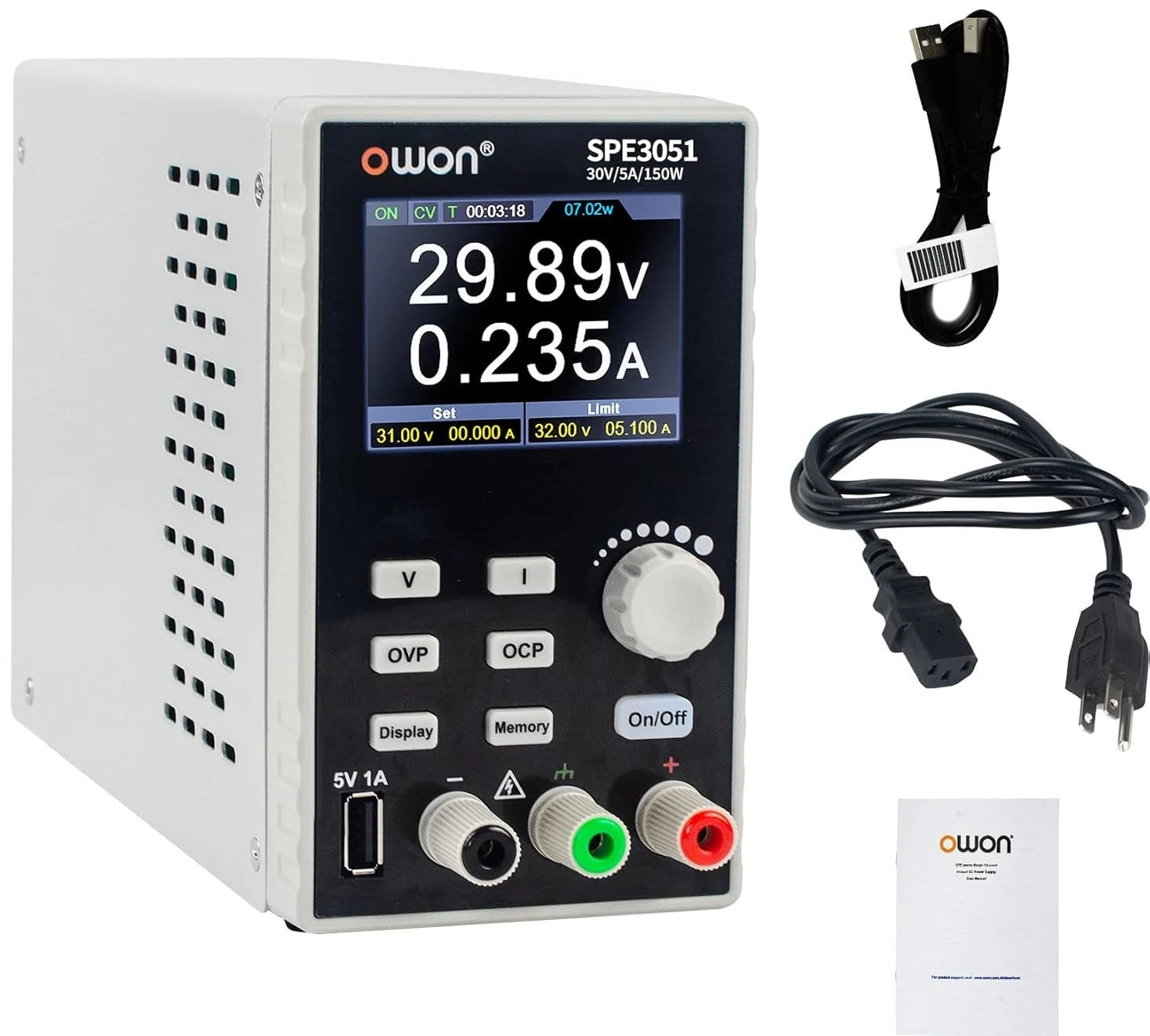
The first power supply in our list comes from a well-established brand OWON with decades of experience in electronic instruments. OWON SPE3051 is a compact, single-channel programmable DC bench power supply that provides a rated output of 0–30V and 0–5A, with a maximum output power of 150W. Its constant power design dynamically adjusts current as voltage changes to maintain safe operation within the rated wattage, allowing a single power supply to cover multiple voltage-current combinations without exceeding limits.
The device features a 2.8-inch TFT LCD display, which can show values for voltage, current, output power, operating time and output status at the same time. The supply also provides constant voltage (CV) and constant current (CC) switching modes. When the current value exceeds the preset current value, it automatically switches to constant current mode to protect the circuit.
With its output ON/OFF button, users can preset voltage and current limits before energizing the load. It also offers programmability and PC connectivity. Additionally, it supports memory presets for quick recall of commonly used voltage/current combinations and offers list waveform editing output.
When it comes to safety the power supply provides multiple protection features—such as current limiting, thermal protection, overvoltage, short-circuit, and overpower protection to help safeguard the circuit and improve overall durability. Moreover, it also features a smart temperature-controlled fan that minimizes noise and helps maintain stable output during extended operation.
Overall this power supply provides dependable performance and is suitable for a wide range of electronics work, from embedded systems and power-rail testing to battery charging and prototyping.
Key features
- Configurable OVP & OCP Limits
- Real-Time Multi-Parameter Display
- CV / CC Intelligent Switching
- List / Waveform Output Mode
- On-Screen Status Indicators
- Memory Presets
- USB charging ports
- Intelligent temperature-controlled fan to reduce idle noise.
- Compact form factor
- Multiple safety features
- Supports RS232 digital communication
- 5V 1A USB port on the front
Technical Specifications
| Output voltage | 0 – 30 V |
| Output current | 0 – 5 A |
| Total output power | 150 W |
| Load regulation (V) | < 30 mV |
| Load regulation (I) | < 20 mA |
| Ripple / noise (Vpp) | <30m Vp-p |
| Memory / presets | 4 groups (model dependent) |
| Display | 2.8" TFT color |
Pros
 Good feature set for the price
Compact, lightweight and space-saving
High Precision Stable Output
Adequate power (150 W) for most student/maker projects
Front USB convenience and PC control for automated tests
Cons
 Switching supply noise
Fan can be loud under load
Who should buy this?
Students, Makers & hobbyists, Repair & field techs
Kiprim DC310S DC Power Supply
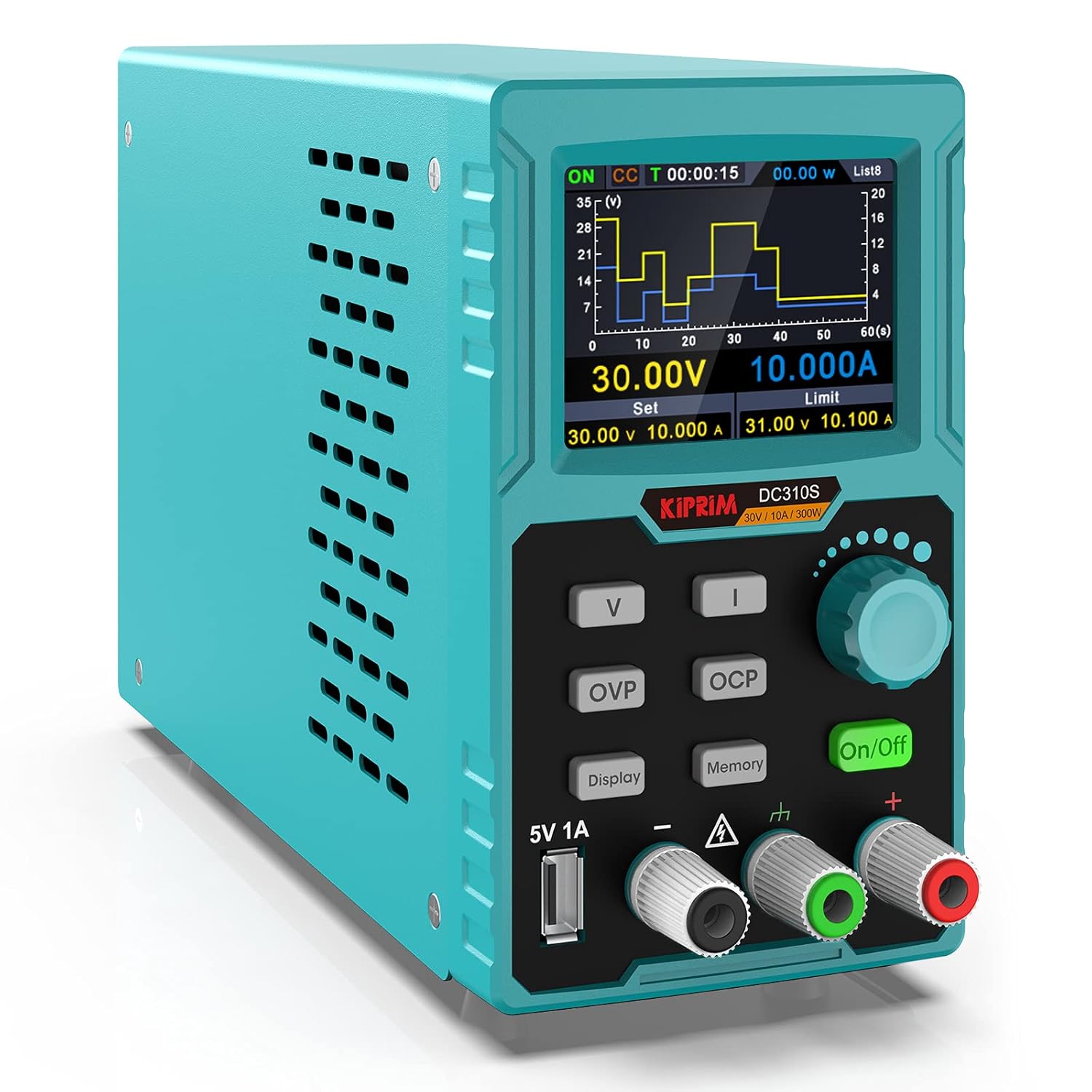
The second power supply in our list is from the brand Kiprim which manufactures reliable and user-friendly DIY tools.
Kiprim DC310S is a feature-rich, budget programmable bench power supply which delivers an adjustable output of 0–30V, 0–10A with a maximum output power of 300W. It features a 2.8-inch color LCD display, which shows both set values and real output values for voltage and current, along with output power, cumulative operating time, channel status, and protection thresholds. Using the DISPLAY key, you can toggle between a numeric readout and a graphical curve view.
The DC310S also adds basic programmability, allowing users to save and recall commonly used settings. Up to four memory presets (M1–M4) can be stored for quick output with support for list waveform output. In this mode, users can define up to 10 editable steps, each with its own voltage, current, duration, and enable/disable status—useful for repeatable testing or simple automated output patterns. An Output Enable/Disable button is also provided, which allows users to preset voltage and current safely before applying power to the load.
For connectivity, the rear USB port enables firmware upgrades and PC-based control, while the front 5V/1A USB port can power or charge small devices such as microcontroller boards.
For safety, the power supply includes configurable protection mechanisms, such as over-voltage protection (up to 31V), over-current protection (up to 10.1A), and over-temperature protection that activates around 85 °C. A smart temperature-controlled cooling fan automatically adjusts its speed based on load conditions, reducing unnecessary noise
Overall the Kiprim DC310S delivers impressive functionality for its price and can significantly upgrade a hobbyist or maker workbench.
Key Features
- Constant Voltage (CV) and Constant Current (CC) Modes
- Programmable Output & List Mode
- Memory Key for quick output
- Output Enable / Disable Control
- Integrated USB Charging Port (5V / 1A)
- Comprehensive Protection Features
- Intelligent Temperature-Controlled Cooling Fan
- Compact and Lightweight Design
Technical Specifications
| Output Voltage | 0–30V |
| Output Current | 0–10A |
| Max Output Power | 300W |
| Voltage Resolution | 10 mV |
| Current Resolution | 1 mA |
| Display | 2.8-inch color LCD (numeric + graph) |
| Memory Presets | 4 (front panel) |
| List/Waveform Mode | Up to 10 steps |
| PC Interface | USB |
| USB Output | 5V / 1A |
| Input Voltage | 110V AC (model-dependent) |
Pros
Excellent feature set for the price
Compact and lightweight footprint
High-resolution display
Good accuracy for the price
Cons
OCP not fast enough for delicate components
Waveform/list programming has a learning curve
Cooling fan can be noisy
Who should buy this?
Electronics hobbyists and makers, Repair technicians, Educational labs and training environments
FNIRSI DPS-150 Programmable DC Power Supply

This power supply is from FNIRSI which is a trusted name in the maker and test-equipment space, known for delivering reliable tools.
The FNIRSI DPS-150 is a portable yet highly capable DC power supply which delivers up to 30 V, 5 A, and 150 W of clean, adjustable DC output.
What immediately sets the DPS-150 apart is its 2.8-inch IPS color display with a 90-degree adjustable tilt. The UI supports both numerical readouts and real-time curve displays. Precise control is handled via tactile buttons and a smooth rotary encoder, enabling accurate voltage and current adjustments.
Unlike conventional bench supplies, the DPS-150 supports multiple input power options. It can be powered via USB-C PD/QC( Power Delivery/Quick Charge) charger, or a standard DC input(5V-32V), you can even run it from the power bank.
For automation and repeatability, the DPS-150 offers PC connectivity via USB, enabling remote control, firmware updates, real-time monitoring, and data logging through official software. Users can store and instantly recall up to six preset voltage/current profiles, and advanced users can take advantage of programmable output modes, including sequential and scanning outputs—features rarely seen in this price range.
For safety, the DPS-150 integrates eight protection mechanisms, including Over-Voltage Protection, Over-Current Protection, Under-Voltage Protection, Over-Load Protection, Over-Temperature Protection, Short-Circuit Protection, reverse-input protection, and reverse-output prevention. During faults such as short circuits or overloads, the supply reacts instantly by switching into constant-current mode or shutting down output, protecting both the device under test and the power supply itself. The low ripple output (< 20 mV) and absence of overshoot make it suitable for sensitive analog circuits.
One point is to be noted that this power supply works in step-down (buck) mode, which means the input voltage must always be higher than the output voltage. It operates safely with an input range of DC 5V to 32V—the output will shut off if the input drops below 5V due to undervoltage protection, and applying more than 32V can damage the device.
Overall, the FNIRSI DPS-150 delivers a combination of precision, programmability, portability, and safety in a compact form factor.
Key Features
- Fine Setting Precision
- Preset 6 output profiles
- Multi-Source Input Flexibility
- PC Connectivity & Firmware Support
- Versatile Output Connectors
- 8 key protection work safety guards
- 20 mV Low ripple for steady and efficient power delivery
- Uses efficient cooling
Technical Specifications
| Output Voltage Range | 0 – 30 V |
| Output Current | 0 – 5 A |
| Maximum Power | 150 W |
| Full Load Efficiency | 96.30% |
| Display | 2.8″ IPS color (320 × 240) with 90° flip |
| Input Voltage Options | DC 5 – 32 V (PD/QC/DC adapters, power bank) |
❕Note
Actual mains AC adapter is not included — a compatible DC source such as a USB-C PD adapter is needed for full output range.
Pros
Space-saving design
Excellent value for money
Versatile for many use-cases
Reduces risk of component damage
Well documented
Beginner-friendly learning curve
Cons
Requires an external DC power source for maximum output
Not ideal for continuous high-power operation
Who should buy this?
Makers, students, repair technicians, and electronics enthusiasts
Jesverty SPS-3010 DC Power Supply

This power supply is from brand Jesverty which is an established test-equipment manufacturer with over a decade of experience in regulated power supplies and measurement instruments.
The Jesverty SPS-3010 switching bench DC power supply provides output of 0–30 V, 0–10 A (300 W). The unit supports automatic Constant Voltage (CV) and Constant Current (CC) mode switching, making it safer for current-limited testing and beginner workflows.
The device features a 4-digit LED display, which shows real-time voltage, current, and calculated power output with decent resolution (0.01V / 0.001A / 0.1W). The coarse and fine adjustment knobs allow users to quickly reach a target value and then dial in finer adjustments, which is practical for everyday bench work.
It offers several built-in safety features—such as short-circuit protection, overload protection, grounding terminal, internal fuse, and a temperature-controlled cooling fan—help ensure stable operation during extended use. A 5V / 2A USB output adds convenience for powering microcontrollers or charging small devices directly from the bench supply.
Jesverty SPS-3010 is a solid choice for general prototyping, repair work, and motor testing.
Key Features
- Automatic CV / CC Operation
- 4-Digit LED Display with Power Readout
- Compact & Lightweight Bench Design
- Integrated Cooling & Protection
- USB-A & USB-C 20W Quick-Charge Ports
- Output ON/OFF Button
- Encoder Coarse & Fine Adjustment Knobs
- Active fan cooling
Technical Specifications
| Input Voltage | AC115V/230V (Selectable) |
| Output Voltage | 0–30V DC |
| Output Current | 0–10A |
| Maximum Power | 300W |
| Display | 4-digit LED |
| Voltage Resolution | 0.01V |
| Current Resolution | 0.001A |
Pros
Excellent power-to-price ratio for a 30V/10A supply
Good build quality for the price
Cons
No programmability, logging, or remote control
Who should buy this?
Students learning electronics, Makers and DIY hobbyists, Repair technicians
💡Must Read
Adjustable DC Power Supply Review – Jesverty SPS-3010V
See the hands-on testing of the Jesverty SPS-3010V DC bench power supply.
Kungber SPS3010B DC Power Supply

The Kungber SPS3010B adjustable DC power supply is a budget-friendly, feature-rich switching bench supply. With a maximum output of 300W, this unit provides both constant voltage (CV) and constant current (CC) operation, along with added conveniences like battery charging mode, Ah (amp-hour) measurement, USB fast charging, and audible over-current alarms—features rarely seen together at this price range.
Moreover, it features a 4-digit LED display that provides clear readings of both voltage and current. When it comes to safety features, Kungber includes overvoltage, overcurrent, overtemperature, and short circuit protection.
This power supply covers most core bench power supply requirements—stable output, real-time monitoring, and essential safety protections—making it a practical choice for DIY projects, module testing, device repair, and general electronics troubleshooting.
Key Features
- Intelligent battery charging mode and Safety Detection
- Separate coarse and fine knobs for voltage & current
- Analog rotary knobs (no digital encoder)
- Multiple Protection Features
- Smart Temperature-Controlled Cooling Fan
- Overcurrent Detection Alarm
- Replaceable 5A Fuse Box
- Coarse & Fine Adjustment Knobs
Technical Specifications
| Output Voltage | 0–30V DC |
| Output Current | 0–10A |
| Max Power | 300W |
| Ripple Noise (CV) | ≤30mV RMS |
| Ripple Noise (CC) | ≤20mA RMS |
| Display Accuracy | ±0.5% + 2 digits |
| Input | 115V AC ±10%, 60Hz |
| Fuse | 5A (110V input) |
Pros
Affordable price
User-Friendly Interface
Compact and lightweight
Durable Construction
Cons
Sensitive knobs make fine tuning frustrating
Fan noise can be intrusive
No programmability or PC interface
Not suitable for sensitive analog / RF work
Who should buy this?
Students, Makers and DIY hobbyists
NANKADF DC Bench Power Supply
The NANKADF DC Power Supply is a compact, programmable bench supply that delivers up to 30 V and 10 A (300 W) of regulated DC power. It also provides automatic Constant Voltage (CV) and Constant Current (CC) operation.
One of its standout elements is the high-precision encoder knob, which allows digit-by-digit adjustment of voltage and current. The unit includes an Output Enable/Disable button, letting users preset voltage and current safely before applying power to the load.
A 4-digit high-resolution LED display shows real-time voltage, current, and operating mode. The display brightness is adjustable, ensuring clear visibility. For safety, the power supply features over-current protection (OCP). If a short circuit or overload occurs, the output is automatically cut off and an audible alert notifies the user.
The unit also includes an 18W USB fast-charging port, allowing users to charge phones or small devices directly from the bench.
The NANKADF is a budget bench supply that punches well above its price. It is well-suited for beginners who want accurate digital control, built-in safety features, and modern usability without stepping into expensive professional lab equipment.
Key Features
- Automatic Constant Voltage (CV) and Constant Current (CC) modes
- High-Precision Encoder Knob
- 4-Digit High-Resolution Display
- Output Enable / Disable Button
- Over-Current Protection (OCP) with Alarm
- Built-In USB fast charging Port
Technical Specifications
| Output Voltage | 0 – 30 V |
| Output Current | 0 – 10 A |
| Maximum Power | ~300 W |
| Display Resolution | 0.01 V / 0.001 A |
| Display Type | 4-digit HD LED |
| Protection | Over-current (OCP), Short-circuit, Thermal |
| USB Port | 1× USB Fast Charge (5 V / 18 W) |
Pros
Affordable price
USB fast-charge port adds convenience
Compact and easy to use
Cons
Build quality is budget-level
Fan can be audible under load
Not programmable or PC-controllable
Who should buy this?
Students, Beginners, Makers and DIY electronics hobbyists
Comparison Table
| Power Supply | Voltage / Current Range | Control Level | Safety & Protection | Best For | Standout Advantage | Best Suited For |
|---|---|---|---|---|---|---|
| OWON SPE3051 | 0–30V / 0–5A | Programmable + PC control | OVP, OCP, OTP, SCP | Precision testing, embedded systems, repeatable lab experiments | Clean output with software control | Advanced hobbyists, serious students |
| Kiprim DC310S | 0–30V / 0–10A | Programmable + memory presets | OVP, OCP, OTP | Battery testing, waveform/list output, learning programmability | Graph display & list mode at mid price | Intermediate learners, makers |
| FNIRSI DPS-150 | 0–30V / 0–5A (150W) | Digital + PC control | OVP, OCP, OTP, SCP | DIY Arduino/ESP32 projects, motor testing | Ultra-compact, USB-PD powered | Students, makers |
| Kungber SPS3010B | 0–30V / 0–10A | Basic knobs + digital display | OVP, OCP, OTP, SCP | General electronics, repairs, battery charging | Strong current at budget price | Beginners, DIY hobbyists |
| Jesverty SPS-3010 | 0–30V / 0–10A | Basic analog control | OVP, OCP, thermal protection | Entry-level lab work, learning CV/CC fundamentals, diy projects | Simple, reliable, affordable | Students learning electronics, Makers and DIY hobbyists |
| NANKADF Bench PSU | 0–30V / 10A (variant-based) | Digital encoder control | OCP, SCP | Small projects, quick tests | Very compact with encoder knob | Budget-focused learners |
How We Selected and Reviewed these DC Bench Power Supplies
To create this list, we followed a structured and practical evaluation process rather than relying on specifications alone. Each DC power supply was shortlisted based on real-world user feedback, technical specification analysis and overall reliability.
We carefully studied official product documentation, user manuals, and manufacturer specifications to verify accuracy, safety features, and operational capabilities. In addition, we analyzed customer reviews to identify recurring strengths, limitations and real usage patterns. Our selection prioritizes electrical stability, usability, protection features and value for money.
Bottom Line
Choosing the right DC bench power supply ultimately depends on what you are building today—and what you plan to build next. If you’re just starting out or setting up your first electronics bench, a simple and safe entry-level supply is more than enough to learn, experiment, and build confidence. As your projects grow more complex — involving motors, batteries, or repeatable testing — stepping up to a higher-current or programmable supply makes practical sense rather than jumping straight to industrial equipment. The key is selecting a power supply that matches your current workload without limiting future growth.
If you need a power supply with professional-grade accuracy, repeatability, and PC-based control for tasks like circuit validation, automated testing, or long-duration experiments, OWON SPE3051 is a strong choice
For beginners or hobbyists working within a tighter budget, the Jesverty SPS-3010 DC Power Supply offers a good entry point.
There’s no single “best” DC bench power supply for everyone—but there is a best one for your specific use case.
FAQ’S
What is a bench power supply used for?
A bench power supply is used to provide a stable, adjustable, and protected DC voltage/current to electronic circuits during testing, development, and troubleshooting. Unlike adapters, it allows you to set voltage and current limits, monitor real-time consumption, and safely power prototypes such as Arduino boards, sensors, motors, and analog circuits without risking damage.
Can I use a bench power supply for battery simulation?
Yes, a bench power supply can be used to simulate a battery by setting the output voltage to match the battery’s nominal voltage and limiting the current to a safe level. This is commonly done for testing embedded systems, motor drivers, and power management circuits.
However, caution is required—bench power supplies do not behave exactly like real batteries, especially during charging or transient loads. For accurate battery behavior, additional protection circuits or battery simulators are recommended.
What’s the difference between a linear and a switching DC power supply?
A linear power supply offers very low noise, excellent stability, and clean output, making it ideal for analog, RF, and precision measurement circuits—but it is larger, heavier, and less efficient.
A switching power supply is compact, efficient, and affordable, delivering higher power in a smaller form factor. Most modern beginner and hobbyist bench power supplies are switching types, while linear supplies are preferred for noise-sensitive applications.
How do I choose the right bench power supply for my application?
Choosing the right bench power supply depends on three core factors:
- Voltage range required by your circuit
- Maximum current your load can draw
- Level of accuracy and protection needed
For beginners and students, a 0–30V, 5A–10A supply with CV/CC modes and protection features is sufficient. Advanced users working on sensitive analog circuits, battery testing, or automation should consider programmable or linear supplies with finer resolution and PC control.
How can a bench power supply help in debugging circuits?
By monitoring real-time current consumption, you can instantly detect short circuits, firmware bugs, or abnormal behavior. Sudden current spikes often indicate wiring or logic errors.
Is a programmable bench power supply worth it for students?
Programmable supplies are helpful if you:
- Repeat tests frequently
- Log voltage/current over time
- Work on automation or power profiling
For basic learning, manual supplies are sufficient.
Should beginners prefer linear or switching power supplies?
Beginners typically benefit more from switching supplies due to size, cost, and efficiency. Linear supplies are better suited for advanced analog or low-noise applications.